By K’Paw Htoo, Saw Hea Say, Doe Doh Moo, and Yogendra Shakya
Introduction
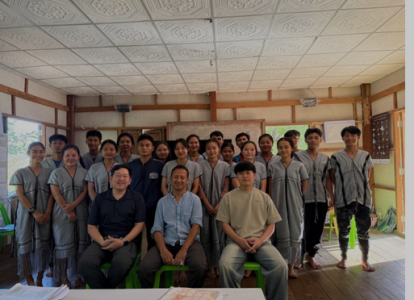
In January 2026, the environmental education team of the Karen Environmental and Social Action Network (KESAN) delivered an undergraduate-level course on environmental justice to Karen/K’nyaw Indigenous students in Kawthoolei, the homeland of the Karen people.
The course, Indigenous Peoples and Environmental Justice Practices, was taught by K’nyaw instructors K’Paw Htoo and Saw Hea Say to third-year students at Dr. T. Thanbyah College and Institutes (TCI), located in Salween Peace Park. This pilot course was supported by funding from the Indigenous Led Education Network (ILED) and the Pastor Rice Small Grant Fund (PRSFG).
A Broader Initiative
This course is part of the Kawthoolei Environmental Curriculum Project, which aims to develop post-secondary education for K’nyaw youth.
The goal is to equip students with the knowledge and practical skills they need to become leaders in environmental justice and stewardship—both in Kawthoolei and beyond.
Learning About Indigenous Environmental Justice
During the course, students explored the rich foundations of kin-centric knowledge and practices held by the K’nyaw community and Indigenous Peoples around the world.
They were introduced to the Indigenous Environmental Justice (IEJ) framework, which emphasizes strong, respectful relationships between people and nature. Students examined key ideas such as relational ontologies and the “gift economy”. These concepts show how communities can move away from extractive, colonial-capitalist systems and instead build relationships with nature based on reciprocity, care, and respect.
Learning from Local Leadership
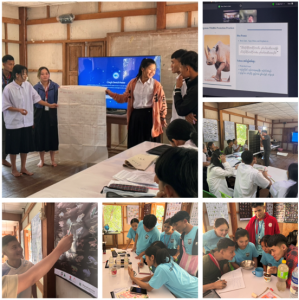
Leaders from the K’nyaw community contributed to the course through guest lectures. They shared insights about:
These parks in Kawthoolei are powerful examples of how IEJ principles can be applied in practice, combining environmental protection with Indigenous governance and community leadership.
Understanding Global Environmental Challenges
The course also addressed urgent environmental issues, including:
- The “triple planetary crises”
- Greenhouse gas emissions
- Land degradation and water pollution
Students learned that more than 80% of global pollution and climate impacts are caused by wealthy countries and large corporations in the West.
In response, the course emphasized the importance of solidarity. Indigenous and other marginalized communities must work together to hold these powerful actors accountable and advocate for environmental justice.
Inspiring Indigenous Youth Leadership
A key focus of the course was to raise awareness of Indigenous youth environmental activists from around the world, including:
Students found this deeply inspiring. Seeing young Indigenous leaders (who share similar backgrounds) take action in their communities and globally encouraged them to see their own potential as environmental leaders.
Hands-On Learning and Immediate Impact
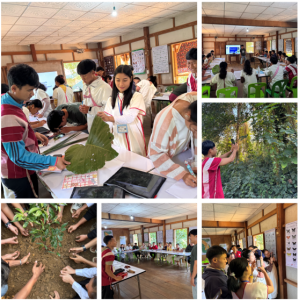
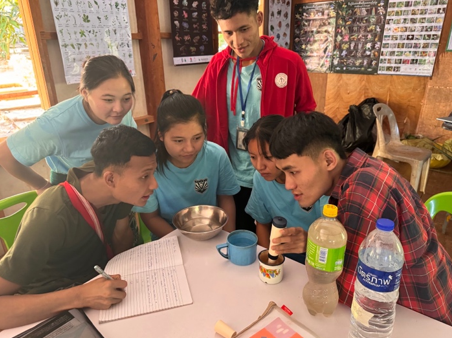
The course placed strong emphasis on practical, hands-on skills. Students learned how to:
- Create a local biodiversity snapshot
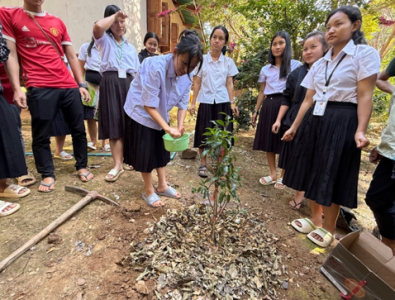
- Plant and care for trees
- Understand how solar energy systems work
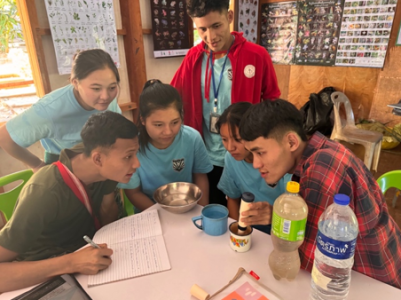
- Conduct basic water testing
- Manage waste and recycling
Students quickly began applying what they learned. For example, they cleaned solar panels after learning how dust reduces efficiency, added mulch to trees, and built a waste-sorting system at TCI.
Inspired by the course, students also decided to start an environmental club on campus.
A Unique Learning Environment
TCI’s location (on the banks of the Salween River and within an 80-acre forest) created an ideal environment for learning.
Students were able to directly observe and interact with biodiversity on campus. The course also used educational materials created by K’nyaw organizations (such as Tenasserim River and Indigenous Peoples Network -TRIPNET), including videos and posters.
Students responded strongly to these locally produced materials, which supported a decolonizing approach to education by centering Indigenous voices and knowledge.
Challenges and Lessons Learned
Language and Translation
One major challenge was translating environmental concepts between English and Karen.
- Some technical terms, such as greenhouse gases or carbon sinks, do not translate easily into Karen.
- Some Indigenous concepts, such as “Kaw” (a land governance system), lose meaning when translated into English.
To address this, the teaching team developed some strategic guidelines about translation:
- Avoid literal translations when they distort meaning
- Use explanations and relatable examples instead
Fortunately, the K’nyaw teachers for this course were fluent in Karen, Burmese, and English and were able to seamlessly deliver the classes in a tri-lingual mode.
Logistical Challenges
The course also faced several practical challenges, including:
- Unstable internet
- Limited electricity
- A shortage of computers
- Security concerns
These challenges were addressed collaboratively by students, staff, and instructors.
A Collaborative Learning Approach
The course was based on a Popular Education framework, which emphasizes shared and participatory learning.
Students actively supported one another, especially those with limited English skills. Regular assessments showed that all students developed a strong understanding of the material, regardless of language barriers.
Looking Ahead
This pilot course highlights the importance of Indigenous-centered, decolonial, and participatory approaches to environmental education.
Building on this success, the next step is to develop three additional courses:
- Renewable energy and green solutions
- Restoring damaged landscapes
- Indigenous-led water and land governance
Together, these courses will form a four-course Environmental Stewardship certificate program for K’nyaw students.